
Shop / SNE-1
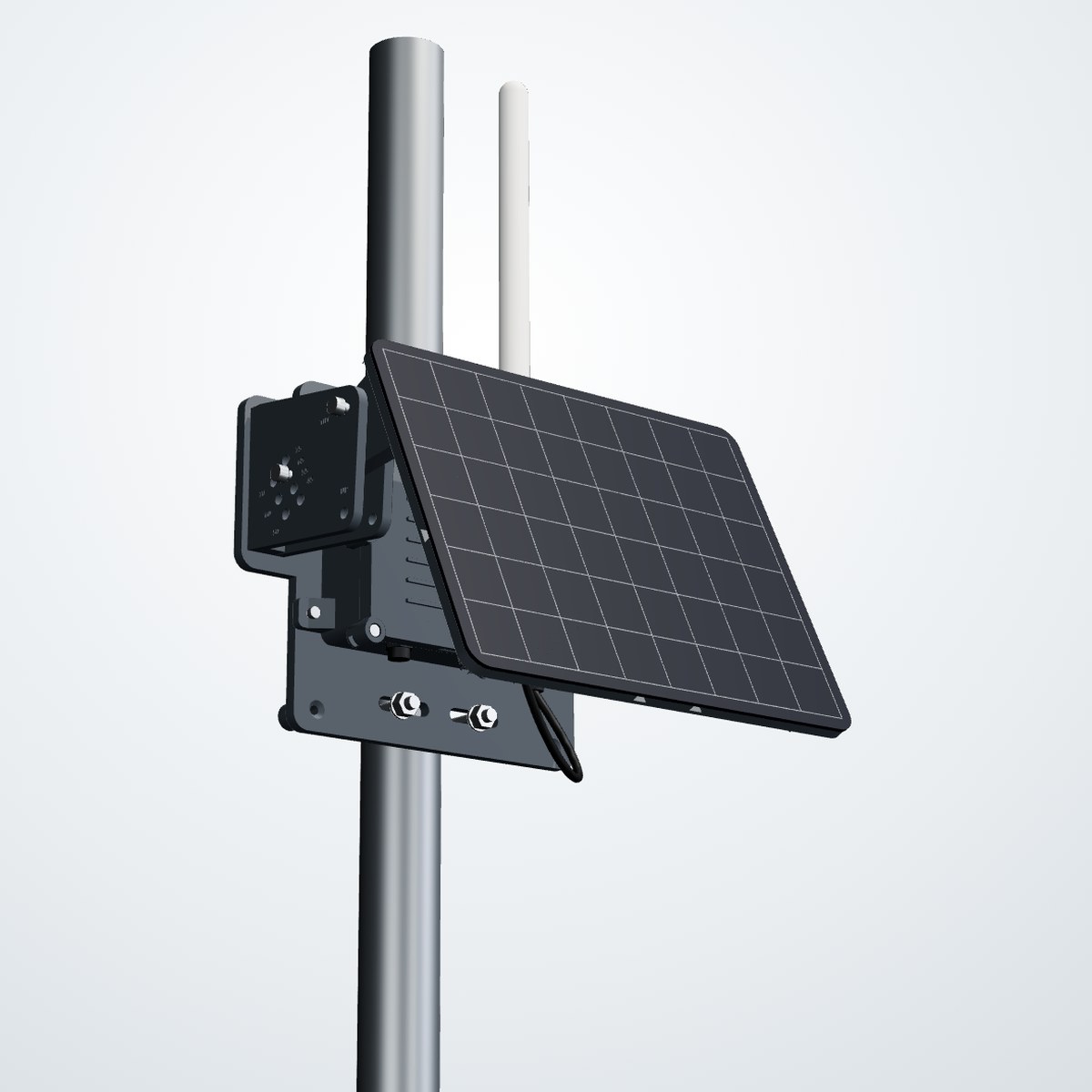
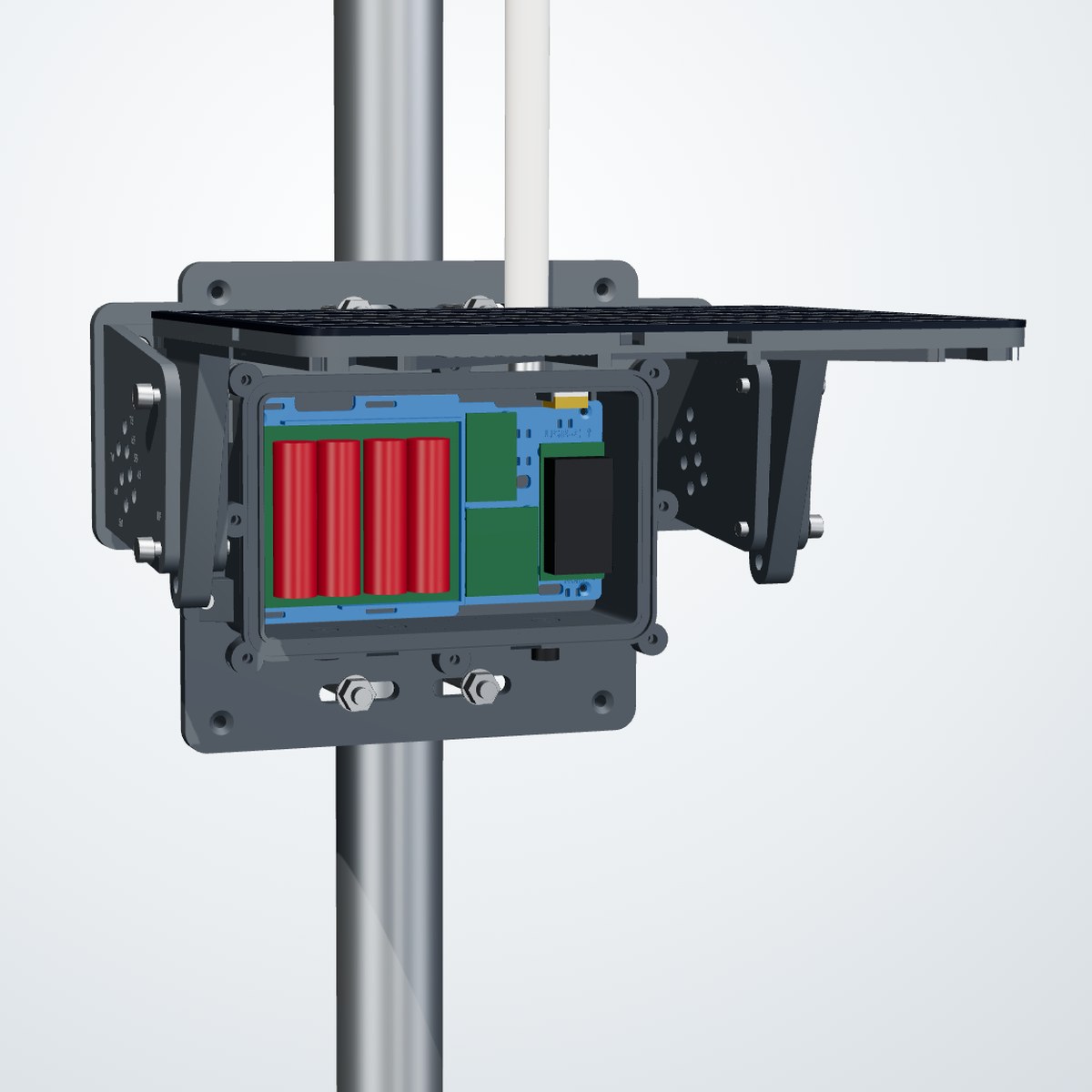
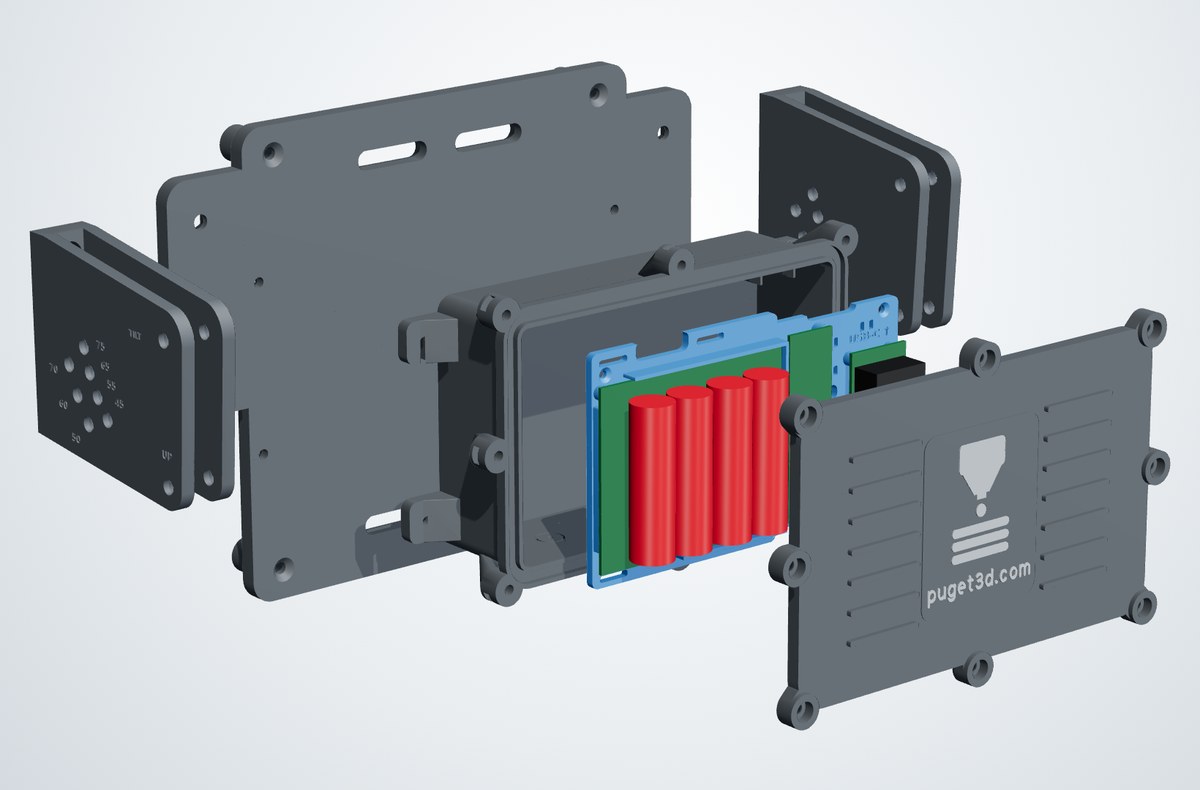
Renders from the v2.12 CAD model, shown with a solar panel, antenna and electronics that are not included.
SNE-1 Solar Node Enclosure Kit
Enclosure only. No electronics are included: no solar panel, RAK or other LoRa boards, charger, power monitor, batteries, battery holder or antenna. You supply those; the kit is the printed enclosure, mount, panel frame and chassis plate with their hardware.
Weatherproof enclosure for solar LoRa mesh nodes (MeshCore or Meshtastic). Gasketed box with breather vent and PG7 gland, a mast or wall mount, a tilting frame for a Voltaic P110 10 W panel, and your choice of chassis plate: the MeshCore build plate, or the generic grid plate for any other build. Electronics, batteries, panel and antenna not included.
- Electronics
- Not included (no panel, boards, batteries or antenna)
- Interior
- 166 × 100 × 48 mm (≈ 0.8 L)
- Box
- 212 × 138 × 51 mm
- Assembled width
- ≈ 285 mm
- Panel
- Voltaic P110 10 W (not included)
- Tilt
- 45–75° in 5° steps, plus an UP service position
- Mounting
- Mast 25–60 mm OD (U-bolts) or wall (4 screws)
- Ports
- 2 × N, 2 × PG7, 1 × M12 vent, all knock-outs
- Chassis plate
- MeshCore build plate or generic grid plate, your choice (boards not included)
- Ingress rating
- Not IP-tested or certified
- Overview
- Specifications
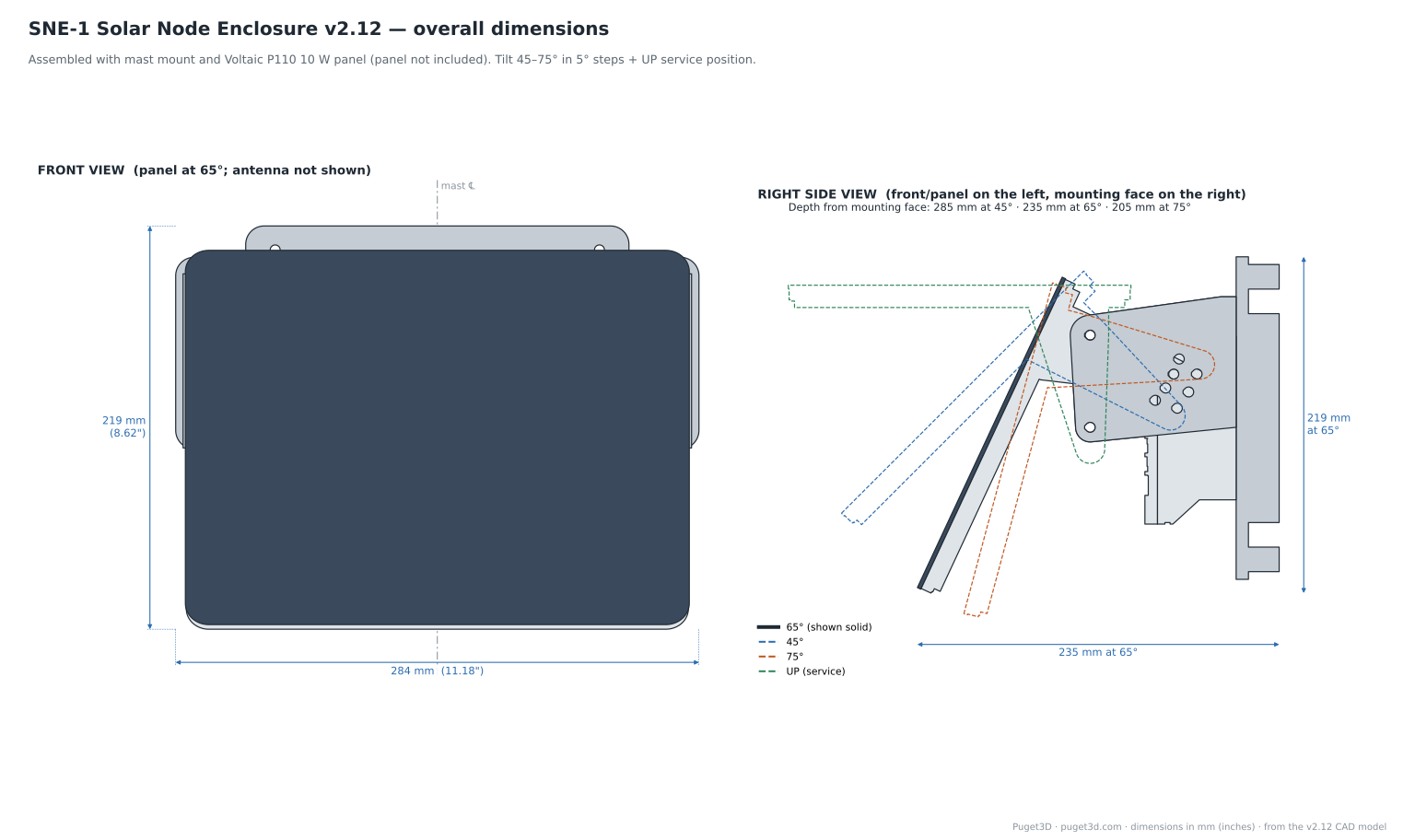
- Dimensions and drawings
- What's in the box
- Chassis plates
- Assembly
- Compatibility
- Care and safety
Overview
A sealed, solar-ready enclosure for off-grid LoRa mesh nodes (MeshCore, Meshtastic) and other small outdoor electronics. The kit is the enclosure only: you supply the electronics, batteries, panel and antenna. The 10 W solar panel hangs in front of the box on a hinged, lockable tilt frame. It shades the box, keeps the whole node about 285 mm wide, and swings up out of the way when you need to open the lid. Every outdoor part is printed in UV-stable ASA. Designed and printed by Puget 3D on the Seattle Eastside, with Pacific Northwest rain and low winter sun in mind.
Panel in front, not beside
A hinged frame carries a Voltaic P110 (10 W) panel. Tilt it from 45° to 75° in 5° steps, locked by a pin through numbered holes so wind can't move it. There's also an UP position for service.
Gasketed lid
A 4 mm silicone foam cord sits in a groove sized for about 30% compression. Eight M4 stainless screws close into captive nuts, so there are no threads in plastic.
Knock-out ports
All five ports print closed: 2 × N-type, 2 × PG7 and 1 × M12 breather vent. Open only the ones you use. Unused ports stay sealed and the outside stays clean.
Breathes, doesn't leak
A pressure-equalising M12 × 1.5 vent faces down, and a desiccant sachet controls condensation.
Swappable chassis plates
Electronics mount on a removable plate held by 4 × M3 brass heat-set inserts (chassis interface I1). Use the MeshCore build plate, the generic grid plate, or design your own on the published pattern.
Mast or wall
One mount plate takes 25–60 mm OD masts (3/4"–2" pipe) with U-bolts, or 4 screws into a wall. A V-saddle on the back centres the mast automatically.
Service in minutes
Pull two pins and flip the panel UP. All 8 lid screws are then reachable, and two 45° pry chamfers lift the lid off the gasket.
Places for the details
A locator for a 15 × 15 mm GPS patch antenna inside the top wall, and an outline for a 62 × 29 mm label (Brother DK-1209) on the lid's inner face.
Specifications
Enclosure (box and lid)
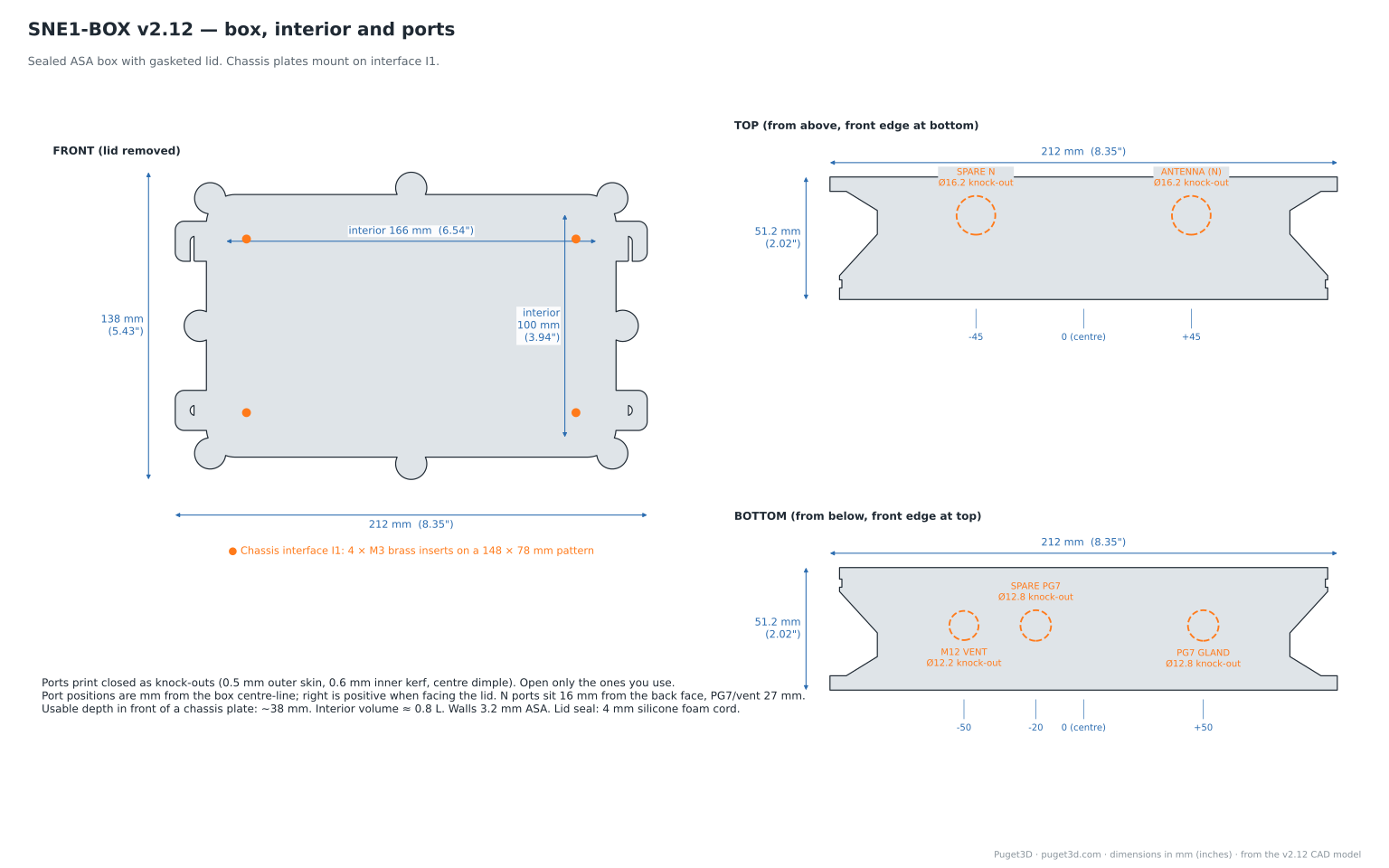
| Box outside (incl. screw lobes) | 212 × 138 × 51 mm (8.35 × 5.43 × 2.02 in) |
|---|---|
| Lid | 204 × 138 × 8.2 mm |
| Interior (usable) | 166 W × 100 H × 48 D mm (6.5 × 3.9 × 1.9 in), ≈ 0.8 L |
| Depth in front of a chassis plate | ≈ 38 mm |
| Walls | 3.2 mm ASA |
| Lid fastening | 8 × M4 × 16 stainless socket-head screws into captive hex nuts |
| Lid seal | 4 mm closed-cell silicone foam cord in a 5.0 × 2.8 mm groove (0.56 m) |
| Chassis interface | I1: 4 × M3 brass heat-set inserts on a 148 × 78 mm pattern, 6 mm bosses (pre-installed) |
| Ingress protection | Designed for outdoor exposure: gasketed lid, sealed glands, downward vent. Not IP-tested or certified. |
Ports (all print as knock-outs)
Positions are seen from the front (facing the lid) and measured from the box centre-line.
| Port | Location | Opened hole | For |
|---|---|---|---|
| Antenna | Top, 45 mm right, toward the back | Ø16.2 mm | N-female bulkhead (5/8"-24) |
| Spare antenna | Top, 45 mm left | Ø16.2 mm | Second N bulkhead |
| Cable gland | Bottom, 50 mm right | Ø12.8 mm | PG7 gland (panel cable, 3–6.5 mm) |
| Spare gland | Bottom, 20 mm left | Ø12.8 mm | Second PG7 gland |
| Breather vent | Bottom, 50 mm left, facing down | Ø12.2 mm, round | M12 × 1.5 vent with O-ring |
Each knock-out is a full-thickness plug held by a 0.5 mm skin on the outer face, with a 0.6 mm groove on the inside along the hole outline. A small dimple marks the centre. It takes a sharp tap with a screwdriver and small hammer to open, so a plug can't be pushed out by accident. The N and PG7 holes are slight "teardrops" so they print cleanly without supports; the vent hole is a true circle so its O-ring seals.
Solar panel frame and tilt
| Panel | Voltaic Systems P110 (10 W, 6 V). Panel not included |
|---|---|
| Panel frame | 273 × 222 × 114 mm, ASA, 8 panel-screw positions |
| Tilt | 45°, 50°, 55°, 60°, 65°, 70°, 75° and UP (service) |
| Lock | M6 index pin through numbered holes in both yokes (ball-lock pins optional) |
| Hinge | 2 hinge yokes, M6 pivot bolts; hinge axis 95 mm in front of the mount plate |
| Panel-to-lid air gap | 37–49 mm, open on all sides (the panel shades the box) |
Suggested tilt for about 47° N (Seattle area): 70–75° in Nov–Feb, 50° in spring and autumn, 45° in summer. 65° is the set-and-forget setting, biased toward winter.
Mounting
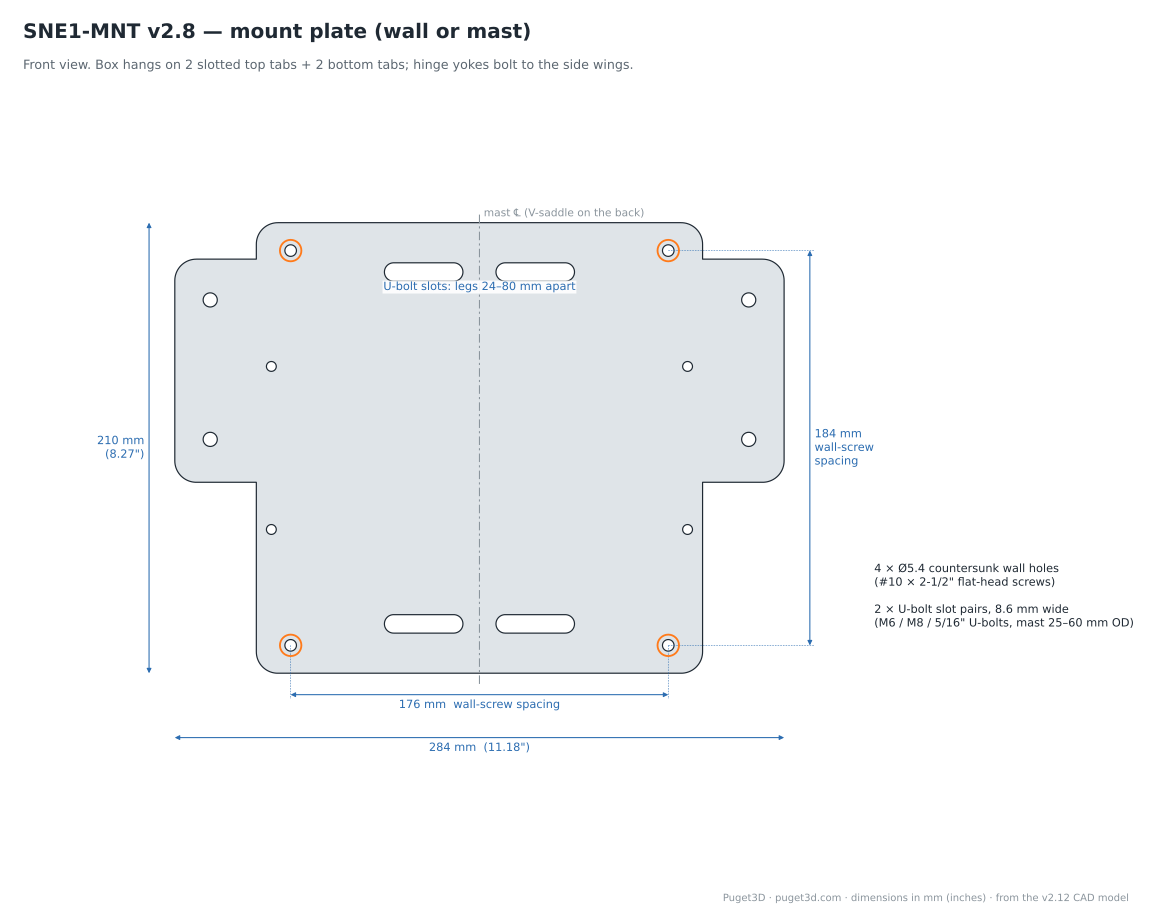
| Mount plate | 284 × 210 × 28 mm, ASA |
|---|---|
| Mast | 25–60 mm OD (3/4" to 2" pipe, 1" EMT), 2 stainless U-bolts. Rod ≤ 8 mm (M6/M8/5/16"), legs 24–80 mm apart |
| U-bolt inside length | ≥ 13 mm + 1.21 × mast OD (e.g. ≥ 53 mm for 1" pipe, ≥ 71 mm for 1-1/2" pipe, ≥ 86 mm for 2" pipe) |
| Wall | 4 × Ø5.4 mm countersunk holes on a 176 × 184 mm pattern; #10 × 2-1/2" flat-head screws into framing |
Overall size (assembled, mast mount, panel fitted)
| Width | ≈ 285 mm (11.2 in) |
|---|---|
| Height | ≈ 219 mm (8.6 in) at 65° |
| Depth from mounting face | ≈ 235 mm at 65° · 285 mm at 45° · 205 mm at 75° |
| Printed parts weight | ≈ 0.9 kg (estimate; plus hardware, electronics and panel) |
Materials
| Box, lid, mount plate, hinge yokes, panel frame | ASA: UV-stable, holds its strength next to a dark panel in summer sun |
|---|---|
| Chassis plates (inside the box) | PETG |
| Hardware | A2 stainless steel |
| Gasket | Closed-cell silicone foam cord |
Branding is by texture contrast in the same filament (no paint or labels outside): a Puget 3D badge on the lid and puget3d.com on the back of the panel frame.
Dimensions and drawings
True-scale projections of the CAD model, in mm with inches. Select a drawing to open it full size.
What's in the box
Printed parts
- 1 × Box (SNE1-BOX v2.12)
- 1 × Lid (SNE1-LID v2.11)
- 1 × Mount plate (SNE1-MNT v2.8)
- 2 × Hinge yokes, left and right (SNE1-YKL / SNE1-YKR v2.8)
- 1 × Panel frame for the Voltaic P110 (SNE1-FRM-P110 v2.11)
- 1 × chassis plate with its screws, the one you choose (below):
- MeshCore plate (SNE1-CP-MC v1.3) with its screws and straps, or
- Generic plate (SNE1-CP-GEN v1.2) with 4 × M3 × 10 countersunk screws.
Mounting pack (the one you choose)
- Mast mount: 2 × stainless U-bolts with nuts and washers, sized to your mast.
- Wall mount: 4 × #10 × 2-1/2" stainless flat-head screws (anchors on request for masonry).
For the mast mount, email orders@puget3d.com with your mast's outside diameter after you order, so the U-bolts fit.
Not included: all electronics
- Solar panel (Voltaic P110), antenna, N-type bulkhead pigtail.
- All electronics: RAK19007 / RAK4631 or any other LoRa board, bq24074 charger, INA3221 power monitor, GPS patch.
- 18650 cells and the battery holder (Geekworm X12-A1).
- Recommended extras: neutral-cure RTV silicone (for the gasket-cord joint), dielectric grease, self-amalgamating tape for the N connector.
Tools you'll need
- Hex keys: 2 mm (M3 countersunk), 2.5 mm (M3 socket head), 3 mm (M4), 5 mm (M6).
- 10 mm spanner (M6 nuts) and a #1 Phillips or 2 mm hex for M2.5 board screws.
- A flat screwdriver and small hammer to open knock-outs, plus a deburring tool or craft knife.
Hardware (A2 stainless)
| Qty | Item | Use |
|---|---|---|
| 4 | M3 brass heat-set inserts (pre-installed) | Chassis-plate bosses |
| 12 + 12 | M4 × 16 socket-head screws + M4 hex nuts | 8 lid screws, 4 box-to-mount-plate |
| 4 | M4 flat washers | Under the box-hanging screws |
| 4 + 4 | M6 × 16 socket-head screws + M6 nuts | Hinge yokes to mount plate |
| 4 + 4 + 8 | M6 × 40 socket-head screws + M6 nyloc nuts + M6 washers | 2 hinge pivots + 2 tilt index pins |
| 8 + 8 + 8 | M3 × 12 screws + M3 nuts + M3 nylon washers | Solar panel to frame |
| 0.6 m | 4 mm silicone foam cord | Lid gasket |
| 1 | M12 × 1.5 pressure-equalising vent with O-ring and nut | Breather port |
| 1 | PG7 IP68 cable gland with locknut (3–6.5 mm cable) | Panel cable |
| 1 | Silica-gel desiccant, 5 g | Inside the box |
Chassis plates
Electronics mount on a removable PETG plate that screws to the box's four I1 inserts. Any plate marked I1 fits any SNE-1 v2 box.
Choose one when you order. The generic plate is $5 less.
MeshCore build plate (SNE1-CP-MC v1.3)
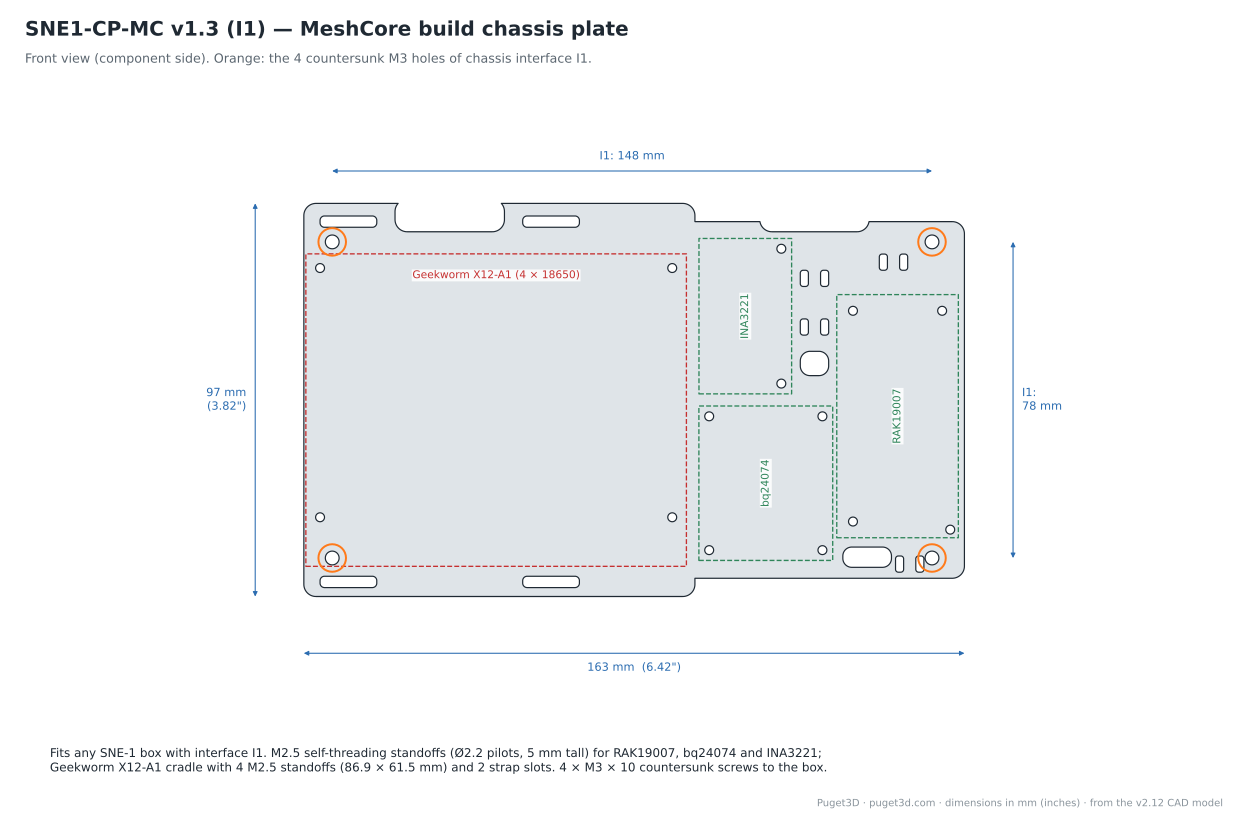
A drop-in plate for a solar MeshCore or Meshtastic repeater. It has a cradle for a 4 × 18650 battery holder and standoffs placed for the RAK WisBlock base, the solar charger and the power monitor. Boards fix with ordinary M2.5 machine screws that cut their own thread into undersized pilot holes, so you don't need inserts or nuts. Debossed labels mark each board's position, the battery's output side, the USB-C direction and the panel-cable pass-through.
| Position (from the front) | Board (not included) | Fixing |
|---|---|---|
| Left two-thirds | Geekworm X12-A1 4 × 18650 holder (93.9 × 77.1 mm; holes 86.9 × 61.5 mm) | 4 × M2.5 standoffs and/or 2 hook-and-loop straps; cradle rails clear the holder's bottom pins |
| Right | RAKwireless RAK19007 base (with RAK4631; USB-C up) | 4 × M2.5 standoffs |
| Centre bottom | Adafruit bq24074 solar LiPo charger | 4 × M2.5 standoffs |
| Centre top | Adafruit INA3221 3-channel power monitor | 2 × M2.5 standoffs |
| Size | 163 × 97 mm, 3.5 mm plate; 10.8 mm overall with the cradle walls |
|---|---|
| Board standoffs | Ø6 mm, 5 mm tall (battery standoffs 3.5 mm), Ø2.2 mm self-threading pilots for M2.5 |
| Box fixing | 4 × M3 × 10 countersunk into the box's I1 inserts (heads flush) |
| Cable routing | Panel-lead slot (bottom right, 12 × 5 mm) and return hole (centre right, 7 × 6 mm), zip-tie slot pairs beside the boards |
| Clearance to lid | RAK 17.9 mm · bq24074 25.4 mm · INA3221 21.9 mm · cells 11.9 mm |
| Notches | Clear the N-bulkhead nuts at both top antenna positions |
| In the pack | The plate, 4 × M3 × 10 countersunk screws (don't use longer), 14 × M2.5 × 8 pan-head screws, 2 × 12 mm hook-and-loop straps (~300 mm), 6 small zip ties. Boards, cells, wiring and antennas are not included. |
Self-threading pilots: drive each M2.5 screw slowly, by hand. The first turn forms the thread; fast driving melts PETG. Stop at snug. Treat each hole as one-time: a screw can go back into its own thread a few times, but it'll loosen eventually. If a screw is very tight, run a Ø2.3 mm drill through by hand.
Generic chassis plate (SNE1-CP-GEN v1.2)
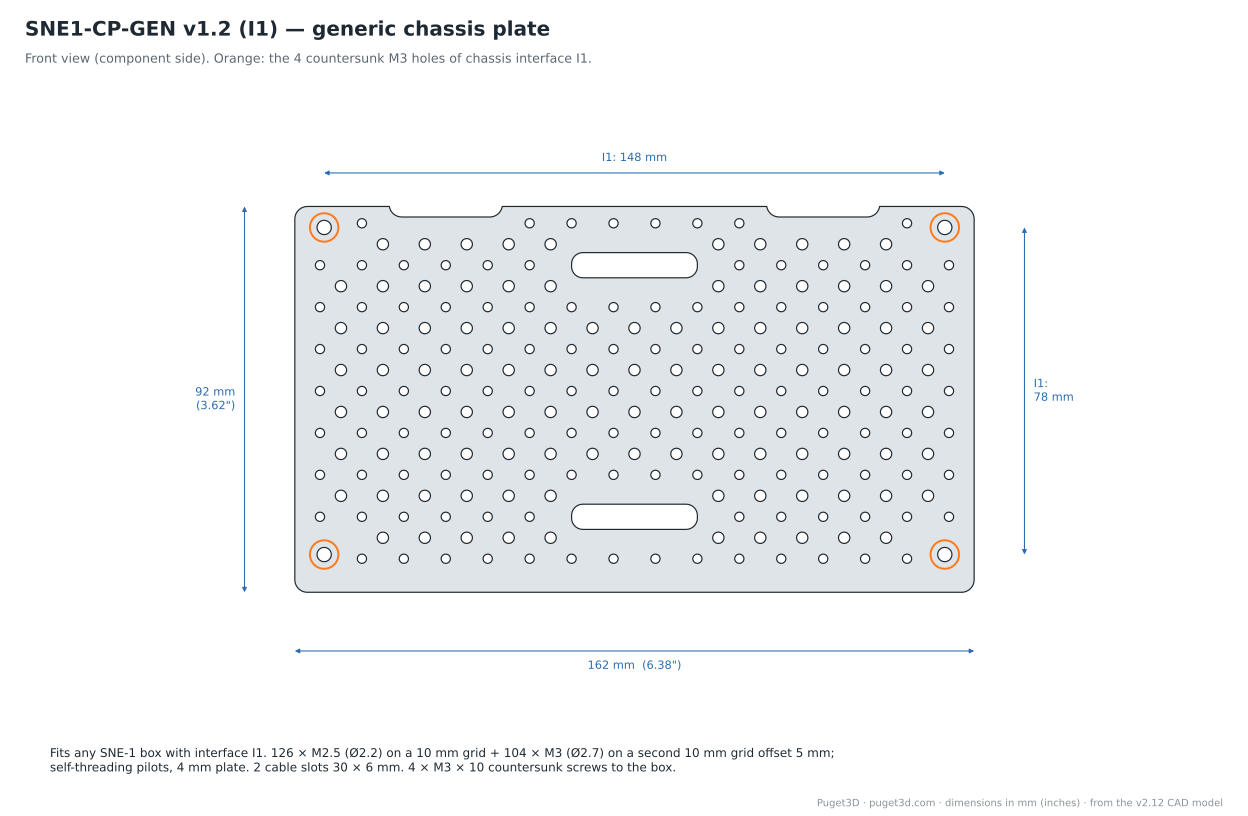
A blank mounting plate for your own build: a Meshtastic node, an ESP32 sensor, a tracker or something new. It's covered in 230 self-threading pilot holes, 126 for M2.5 screws and 104 for M3, on two interleaved 10 mm grids. Wherever a board's mounting holes fall, there's a hole for it within about 5 mm. Drive a screw or nylon standoff straight in and it cuts its own thread, so you don't need nuts, inserts or drilling. The plate screws into the box's four brass inserts, so your whole build lifts out in one piece for service.
- 4 mm thick, so a screw gets a full 4 mm of thread even without a standoff.
- Two 30 × 6 mm slots for routing cables or zip ties.
- Notches that clear the antenna bulkhead nuts at both top antenna positions.
- About 38 mm of usable depth in front of the plate.
- A small puget3d.com mark along the bottom edge, so no holes are lost to branding.
| Size | 162 × 92 × 4 mm, PETG |
|---|---|
| Pilot holes | 126 × M2.5 (Ø2.2 mm) and 104 × M3 (Ø2.7 mm), self-threading, on offset 10 mm grids |
| Box fixing | 4 × M3 × 10 countersunk into the box's I1 inserts (heads flush) |
| In the pack | The plate and 4 × M3 × 10 stainless countersunk screws. Electronics and standoffs are not included. |
Tips: male–female nylon standoffs work well: the male thread self-taps into a pilot hole and keeps solder joints off the plate. Drive each screw slowly by hand and stop at snug. Each hole is good for one thread-forming, but there are plenty to spare.
Assembly
The illustrated guide covers every step, the service position and the hardware for each joint.
Assembly guide (PDF, 7 pages, 1.9 MB)
- Test-fit nuts and ports.
- Open the knock-outs you need.
- Fit the ports (N bulkhead, PG7, vent).
- Drop the captive nuts into place.
- Bolt the yokes to the mount plate.
- Mount the plate on the mast or wall.
- Hang the box.
- Build the electronics on the chassis plate and fit it.
- Seat the gasket and close the lid.
- Fit the panel and set the tilt.
Service
Pull both index pins, swing the panel up to horizontal and pin it through the UP holes. All 8 lid screws are then reachable. To lift the lid off the gasket, twist a flat screwdriver in one of the two 45° pry chamfers on the bottom edge. To remove the MeshCore plate, take the battery out first: it covers the two left plate screws.
Compatibility and versions
- Versioning: v<major>.<minor>. A new major version means parts no longer fit older versions. A new minor version is a compatible improvement. Parts move independently, so a v2.12 kit uses a v2.12 box with a v2.11 lid.
- Interface I1: any chassis plate marked I1 fits any SNE-1 box with I1 (4 × M3 on 148 × 78 mm). The plate drawings above let you design your own.
- Panel: the frame is sized for the Voltaic P110 (≈ 258.7 × 207.2 mm hole spacing). Other panels need a different frame.
Care and safety
- Fit the box with the vent and gland facing down, and give the panel cable a drip loop.
- Lithium cells: use protected or BMS-managed 18650s and a charger with temperature cut-off. Don't charge below 0 °C. Keep cells away from the lid screws when closing. A sealed box in summer sun runs warm; the panel shading the box helps.
- Check the lid screws and pins after the first storm season. Replace the desiccant when you open the box.
- ASA is UV-stable, but no plastic part is forever: inspect the hinge yokes and pins yearly.
Shipping
Shipped within the US by USPS, or local pickup on the Eastside. Rates are shown at checkout.
Returns
Problems with an order? Contact us and we'll make it right. Return policy.
Custom changes
Want a different size, color or material? Ask for a quote instead.